Passing Down the Allman Brothers Band: A First-Listen Guide and Youth Pieces to Match

On March 26, 1969, six musicians in Jacksonville, Florida, held their first rehearsal together. Within days they were playing the Jacksonville Armory, and by April they had moved to Macon, Georgia. The band had two guitarists and two drummers, and it went on to become one of the great live bands in rock history: the Allman Brothers Band.
If there is a young listener in your life, a kid who has just picked up a guitar or a teenager raiding a parent's record shelf, this band is one of the easiest doors into classic rock. Here is a simple way in, record by record, and the youth pieces that go with each step.
Why start a young listener with the Allman Brothers Band?
Because you can hear exactly who is playing what. The original lineup was Duane Allman on slide and lead guitar, Gregg Allman on vocals and keyboards, Dickey Betts on guitar and vocals, Berry Oakley on bass, and Butch Trucks and Jai Johanny "Jaimoe" Johanson on drums.
Two guitars trading lines and two drummers locking together make a great listening game: put the music on and ask which guitar is which, or try to follow one drummer through a whole song. The band drew on blues, rock and jazz (it never much liked the "Southern rock" label), so a kid who gets into these records gets a crash course in all three at once.
Where should the listening start?
A short, five-step path works well. Each step is a record, in the order the band made them.
- The Allman Brothers Band (1969). The debut. Start here to hear the band as it first sounded, raw and blues-heavy.
- Idlewild South (1970). The second record, made in the year the band moved into the Big House in Macon.
- At Fillmore East (1971). The live album recorded in March 1971 at the Fillmore East in New York and released that July. This is the breakthrough, and the record that made the band's name as a live act.
- Eat a Peach (1972). Part studio, part live, and home to some of the band's most loved artwork.
- Brothers and Sisters (1973). The band's first number one album, with the single "Ramblin' Man". Chuck Leavell joined on keyboards for it.
If you only have time for one, make it At Fillmore East. Live records suit young ears: you can hear the room, the crowd and the band stretching out.
Which piece goes with the live record?
The At Fillmore East era is all about the stage, and the black-and-white band photograph from that time is the band's most recognisable image. It sits front and centre on the At Fillmore East photo youth crewneck, a good pick for a kid who has just discovered that live albums are a thing.
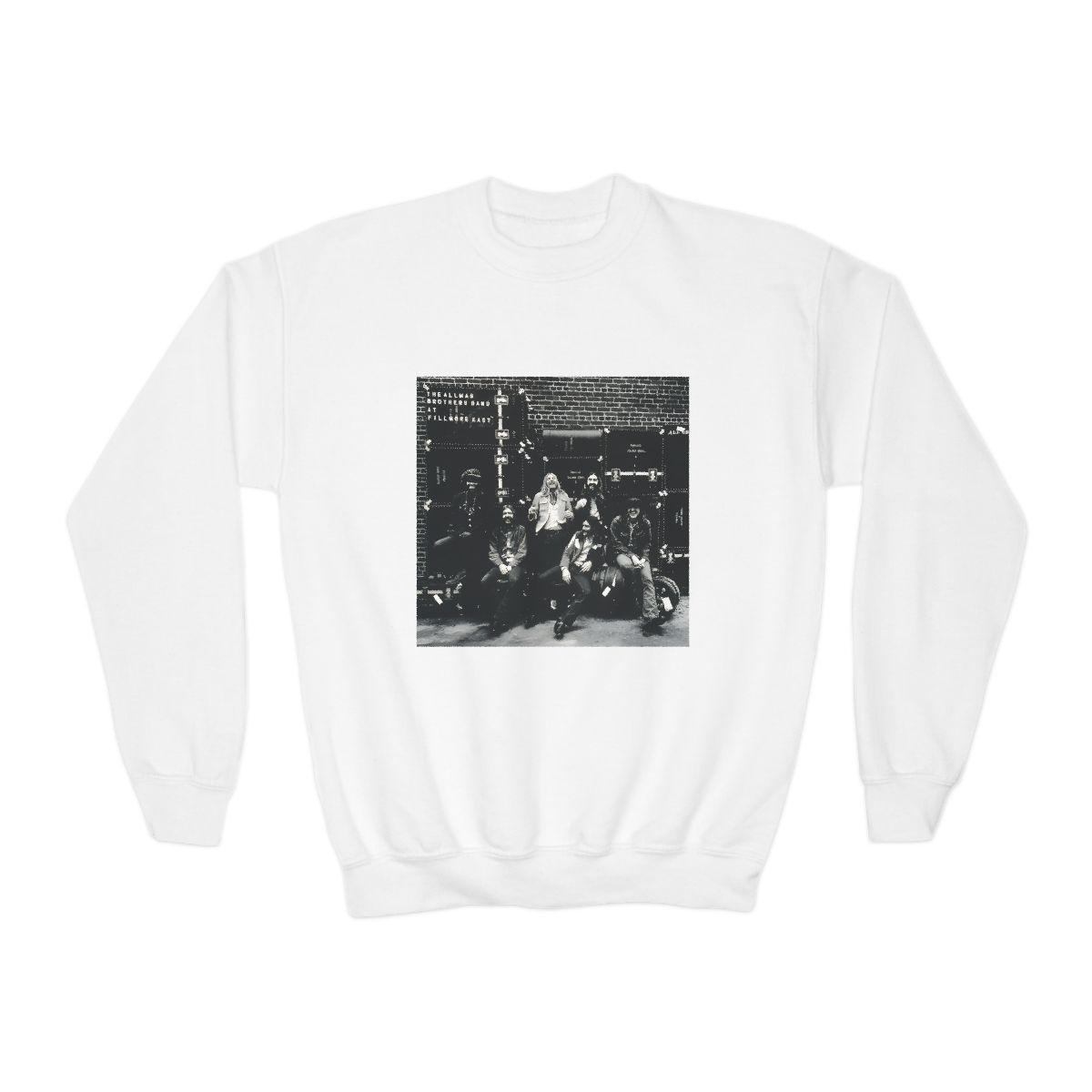
A crewneck is an easy everyday layer: over a tee for school, on its own on a cool evening. The same photo also comes on a youth hoodie for colder months.
What about Eat a Peach?
Eat a Peach is the record with the playful look: the red-orange peach and the green truck. It is bright, cheerful and instantly recognisable, which makes it a natural favourite for younger kids who are drawn to colour before they are drawn to guitar solos.
The Eat a Peach truck youth hoodie carries that artwork, and it is the one to reach for when the listener in question is still small enough to care more about the peach than the liner notes.

There is also a framed version of the peach truck on youth crewnecks and hoodies, and a set of 1969 mushroom designs, including a Macon, Georgia mushroom badge, that point back to the band's first year and its adopted hometown.
What is the story worth telling as they listen?
The Allman Brothers Band story has highs and real sadness, and it is worth telling honestly, at whatever level suits the listener.
- Macon and the Big House. From 1970 the band lived in a Tudor Revival house at 2321 Vineville Avenue in Macon. Today it is The Allman Brothers Band Museum, a reminder of how much the band and the town meant to each other.
- Losses. Duane Allman died in a motorcycle crash in Macon on October 29, 1971, aged 24, just months after At Fillmore East came out. Berry Oakley died after a motorcycle crash in Macon on November 11, 1972. That is why Eat a Peach and Brothers and Sisters sound like a band carrying on.
- Recognition. The band was inducted into the Rock and Roll Hall of Fame in 1995.
- A long road. The band was active from 1969 to 1976, from 1978 to 1982 and from 1989 to 2014. Its final show was on October 28, 2014, at the Beacon Theatre in New York, closing with "Trouble No More". Gregg Allman died on May 27, 2017.
A run of more than four decades, from an armory in Jacksonville to a theatre in Manhattan, is a good lesson for any young musician: keep playing.
How do you make it stick?
A few small ideas that work better than a lecture:
- One record a week. Follow the five-step path above, one album per week, and talk about what changed.
- Count the drummers. On the live tracks, see whether they can pick out the two drummers.
- Find Macon on a map. Then Jacksonville, then New York. The band's story is a road trip.
- Match the piece to the record. The Fillmore photo for the kid who loves the live album, the peach for the one who loves the colourful cover.
Give a young listener a great record and something to wear that ties back to it, and you have handed down more than a song: you have handed down a band that started with six musicians in a rehearsal room in 1969 and is still worth discovering today.